The Science of Speed
Is Finnish downhill really growing again?
We counted every Suomi Cup and SM result since 1990 to see if the longer start lists are real.

For the last few seasons the start lists at Suomi Cup races have felt longer, and more and more people around the sport have been saying that downhill in Finland is on the way back up. We wanted to know if the results back that up, or if it is just a good feeling from a few busy race weekends.
SuomiDH keeps an archive of Finnish downhill results going back to the first national championship in 1990. We put every Suomi Cup and SM (Finnish Championship) result from that archive into one dataset. That gives 166 race days, 13,434 timed results and a little over 1,600 riders across 37 seasons. The full method is at the end of the post. The short version is that we counted the main national series only and left out side series, so that every season is measured the same way.
The low point was 2015
Finnish downhill had a strong decade in the 2000s. In 2006 there were eight national race days and 217 different riders took part, which is still the record. After 2012 the numbers fell quickly. In 2015 the calendar was down to three race days and 79 riders.
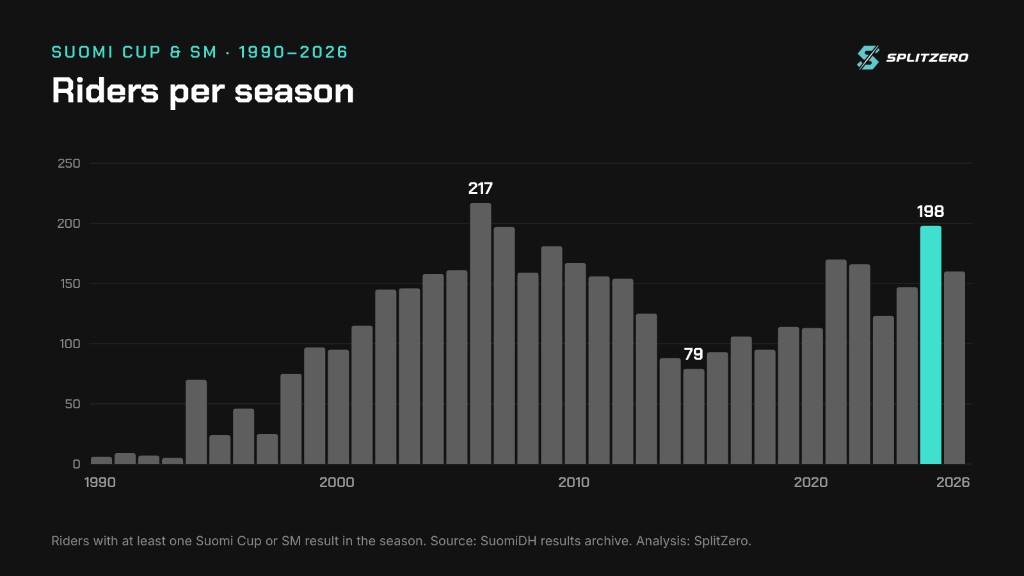
Since 2015 the number of riders has more than doubled. In 2025, 198 riders raced in the Suomi Cup and SM. That is level with 2007 (197) and behind only 2006.
| Season | Race days | Riders | Riders per race day | First-time riders |
|---|---|---|---|---|
| 2006 | 8 | 217 | 77 | 93 |
| 2007 | 5 | 197 | 80 | 83 |
| 2011 | 4 | 156 | 93 | 37 |
| 2015 | 3 | 79 | 48 | 26 |
| 2021 | 6 | 170 | 74 | 91 |
| 2025 | 6 | 198 | 84 | 86 |
| 2026 | 5 | 160 | 78 | 58 |
Is it just more race days?
A season with six race days will collect more riders than a season with three, even if the size of each race stays the same. So before trusting the headline number we checked it against a second one: the average number of riders with a final result on each race day.
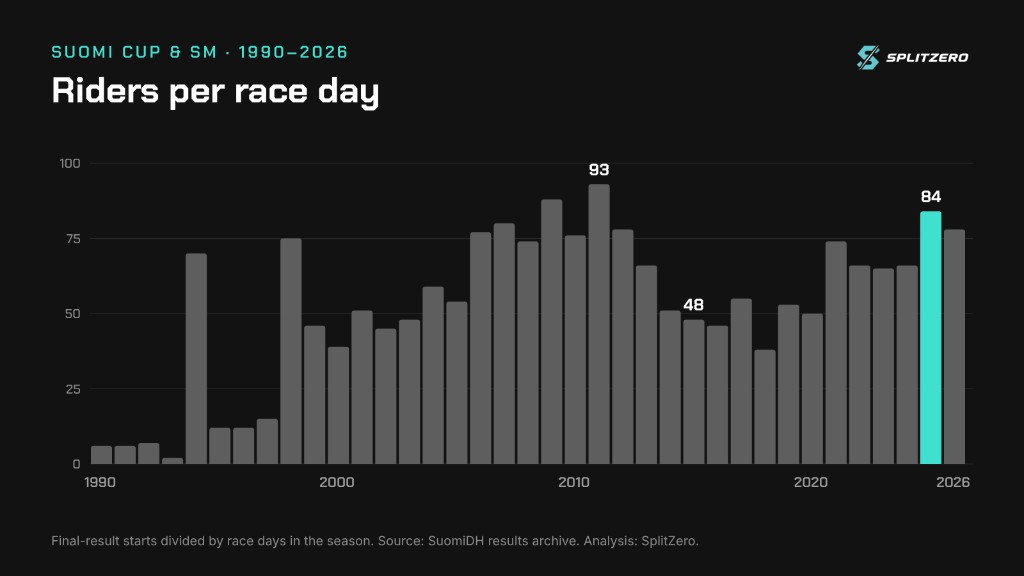
The second metric tells the same story. In 2015 an average race day had 48 riders in the final results. In 2025 it had 84. Only 2009 (88) and 2011 (93) were higher. The races themselves are bigger, so the growth isn't coming from the calendar alone.
The 2025 SM at Ruka had 104 riders in the final results, the biggest single field since 2012.
| Season | Race | Riders in final results |
|---|---|---|
| 2007 | Himos, DH-cup final | 117 |
| 2009 | Sappee, SM | 113 |
| 2011 | Laajavuori, SM | 107 |
| 2012 | Messilä, Cup #5 | 106 |
| 2025 | Ruka, SM | 104 |
The growth is coming from new riders
In 2021, 91 riders raced their first Suomi Cup or SM race. That was more than half of everyone who raced that season, and close to the 2006 record of 93. Another 86 riders started in 2025.
This matters for the long run. A sport that grows only by keeping the same riders for longer eventually runs out of riders. One that brings in close to a hundred new racers a season has something to build on.
2026 came in lower
The 2026 season had five race days and 160 riders, which is 38 fewer than 2025. Riders per race day fell from 84 to 78, and first-time riders from 86 to 58. That is a real drop. It still leaves 2026 above every season from 2012 to 2020, but one quieter season after a record-level one is a reason to keep watching the numbers, not to call the trend.
The 2010–2011 peak that wasn't
Our first count showed a big spike in 2010 and 2011, with 14 and 15 race days a season. When we listed those race days one by one, only six in 2010 and four in 2011 were Suomi Cup or SM races. The rest came from two side series that ran at the same time: the NKC series (2010–2013) and a winter DH series (2010–2011). With those left out, 2010 had 167 riders and 2011 had 156. Both are well below 2025.
We checked the 2010 SM against the results Cyclingnews published at the time. The winners (Toni Berg and Katja Lähteinen), the top five elite men and the size of the elite men's field (31 riders) match the archive exactly.
Should winter racing come back?
The winter series is worth a second look on its own. Between February and March in 2010 and 2011 it ran seven race days at Messilä, Antikkala, Laajavuori, Kalpalinna and Sappee. Those races had 280 starts from 127 different riders, in the part of the year when there is otherwise no racing at all.
We don't know yet whether there is appetite for it today. If you raced those winter races, or would race a new winter series, let us and SuomiDH know.
SplitZero — The Science of Speed.
Sources: SuomiDH results archive, 1990–2026 (results provided by SuomiDH); Cyclingnews: Finnish Downhill Championships 2010 results; Maastopyöräily: DH Suomi Cup.
Methodology: Counts include Suomi Cup and SM races only. The NKC series (2010–2013), winter DH races and regional or city races are excluded. An SM and a Suomi Cup round held on the same day count as one race day. Riders are counted once per season, and a start is one race day with a final result. Team prefixes, bib numbers and known spelling variants were stripped from rider names before counting, but some duplicates likely remain, so rider totals are accurate to within a few riders. Several 2017–2021 result sheets had merged age classes; class-level results from those years were not used.